All print versions of Fifty Four now available digitally Explore the Digital Library →

Onduli Ridge

An exclusive retreat in the heart of the Namibian wilderness, brought to you by

the multi-award-winning conservation travel company, Ultimate Safaris.

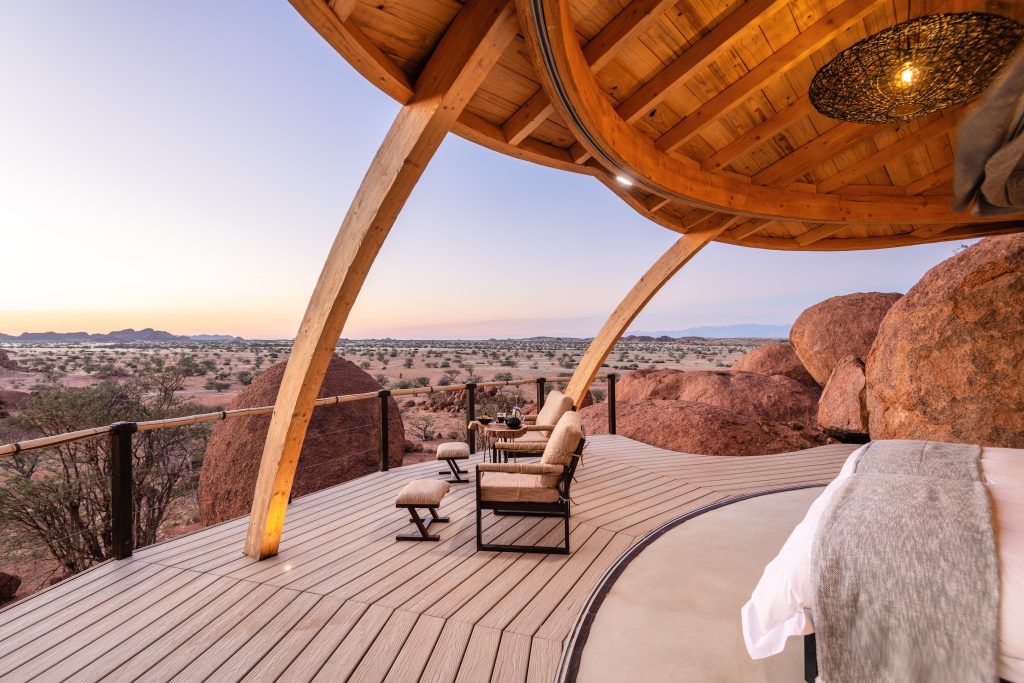
Located in the heart of the pristine Namibian wilderness, Onduli Ridge awaits as an exclusive retreat brought to you by Ultimate Safaris, the multi-award-winning conservation travel company. Situated at the base of two majestic south-facing granite outcrops, this remarkable camp in Namibia’s Damaraland region offers an extraordinary escape into nature’s embrace. Aptly named after the resident giraffe that gracefully roams the area, Onduli Ridge provides guests with an unparalleled experience amidst breathtaking natural beauty. With awe-inspiring vistas of Namibia’s highest mountain, the Brandberg, and the captivating granite inselbergs, this haven serves as a sanctuary for nature enthusiasts and adventurers alike. Join us as we delve into the remarkable features and unique offerings that make Onduli Ridge a truly exceptional destination.

Unforgettable Suites in Harmony with Nature

Onduli Ridge boasts six hidden suites, artfully integrated within the granite boulders that embrace the camp. The temperate climate of central Damaraland allows for naturally ventilated suites, immersing guests in a refreshing ambiance. The partial open-air bathrooms and open communal areas invite the surrounding landscape indoors, providing an immersive experience that blurs the boundaries between nature and luxury.

Each suite is thoughtfully designed to maximise the awe-inspiring views. Whether you’re lounging on the bed, sitting at the desk, or even in the bathroom, every space becomes a viewpoint to behold the captivating surroundings. The louvered shutters can be fully opened to embrace the natural elements or closed for complete privacy, offering a seamless blend of comfort and tranquility. As a special treat, the king-sized beds are equipped with their own ‘climate conditioner’ called Evening Breeze, ensuring a cool and restful sleep.

Indulge in Unrivalled Amenities and Experiences

Onduli Ridge is a testament to meticulous attention to detail and an unwavering commitment to guest satisfaction. The camp offers an array of amenities, including spacious communal lounges, a library, a dining room, a bar, and a campfire circle. The infinity pool invites relaxation, while the crafted pizza evenings and artisan coffee tantalize the taste buds after a day filled with extraordinary activities.

Surrounded by the natural wonders of Damaraland, Onduli Ridge provides opportunities for unforgettable adventures. Immerse yourself in the local wildlife by observing the waterhole, where various animals gather for refreshment. The camp offers the use of Swarovski binoculars, ensuring an enhanced wildlife viewing experience. Engage in guided walks, nature drives, and cultural encounters to fully immerse yourself in the magic of this enchanting region.
Sustainability and Convenience

Onduli Ridge takes pride in its commitment to sustainability, operating as a 100% solar-powered camp. This ensures a minimal ecological footprint while allowing guests to enjoy a truly eco-friendly experience. Additionally, the camp offers WiFi in the rooms, enabling guests to stay connected with loved ones and share their unforgettable moments in real-time.

Getting to Onduli Ridge is convenient, with its own airstrip located a short 20-minute drive from the camp. Guests can also opt for a self-drive adventure, meeting at the airstrip and then transferring to the camp. The waiting lounge and bathroom facilities at the airstrip provide comfort and convenience for travellers.

Visit Onduli Ridge

A Luxury Path into Africa : a new era unfolds

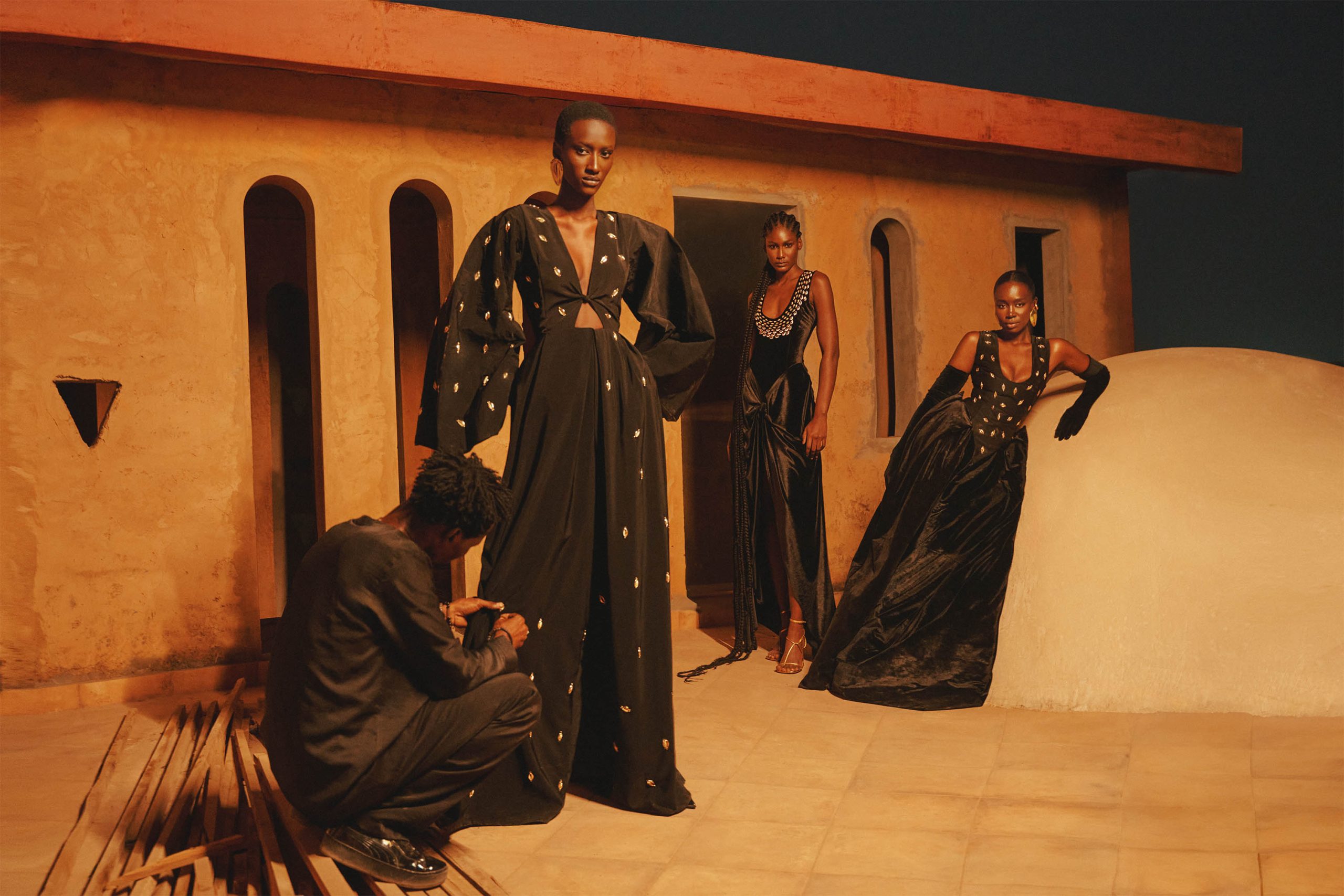
As a burgeoning market, Africa is a significant producer of raw materials like cotton, has and continues to create internationally acclaimed designers, and possesses a rising middle class. UNESCO estimates that the continent’s luxury goods industry brought in an estimated US$6 billion dollars in 2022. 

Leading global brands are taking notice and as a response, are cautiously gaining a deeper foothold in key markets on the continent.

Rising fashion superpower 

In 2023, French fashion house Balmain launched its first stand-alone flagship store in South Africa. Newer high-end labels like Paris-based Casablanca and LA-label Amiri, which capture the zeitgeist with an alternative take on modern luxury, also made their entry into the country in collaboration with Yawa, a local fashion distributor and store selling streetwear-focused names like Off-White and Daily Paper. 

Other advanced fashion markets, such as Morocco, have the same effect. In 2022, Aksal Luxury, one of the country’s top-tier fashion distributors and development companies with franchise agreements with LVMH and Richemont, added Bottega Veneta to its wide roster of storied fashion houses, further indicating the growing buying power and appetite of the African luxury consumer.  

Nicolene Anley is the co-founder and director of Luna Belle Ventures, a newly launched Cape Town-based agency that brings global names like CHIMI and Golden Concept to South Africa. According to her, increased access to global brands combined with tourism has shaped the progression of the industry. She says, “Access has broadened the horizons of local shoppers and the interests of global brands alike.” However, despite the current buzz, Western luxury brands have always considered the continent a dynamic market worth exploring. The availability of Western brands on the continent is not a new phenomenon. Countries like South Africa, Nigeria and Morocco have had some access to European luxury for decades. This is through regional fashion distributors like the aforementioned Aksal Luxury or the Apsley Group, which runs high-end boutiques in Cape Town and Johannesburg, offering the likes of Hermes, Valentino and Dior to discerning South African consumers. In Nigeria, multi-brand local boutiques like Temple Muse have been responsible for introducing a diverse mix of international and regional names, including Christian Lacroix, Givenchy, Lisa Folawiyo and Ituen Basi.

Evolution of African luxury

The term luxury has taken on a new meaning for the region in recent years. “Historically, luxury in Africa was often associated with Western brands and limited to a small elite demographic,” explains Sumendra Chetty, a fashion buyer for Merchants on Long, one of South Africa’s leading boutiques. 

With a focus on crafts, local sourcing and traditional materials, African designers are building strong labels cherished locally and globally. Temple Muse’s retail operations and client service manager, Orwi Manny Ameh says that African fashion has always defined the philosophy of luxury. “Our indigenous processes of hand-making things, be it crafts, arts or fashion, is the core element of luxury. The West didn’t teach us luxury, not the making or consumption of it.” 

Raeesa Brey, a South African strategist at London-based trends forecasting company WGSN, believes that the rise of African luxury can also be attributed to projects like the BRICS+ Fashion Summit, which gives exposure and offers investment opportunities to brands from emerging markets. 

Brey notes that competitions such as the International Woolmark Prize and the LVMH Prize, which in 2019 was awarded to an African designer, Thebe Magugu, for the first time since its launch, have been a “turning point” for brands. These competitions often come with cash prizes, mentorship and global press coverage, and are instrumental in boosting the profiles of designers and legitimising the industry. 

On the continent, local investment firms like Birimian are also helping to solidify the market through incubator support, financial backing, strategic advice and educational opportunities to equip creative entrepreneurs with the skills to develop their businesses.

Music and tech effect 

Before the online boom and the introduction of local boutiques that distribute international brands, African consumers had to travel overseas to shop for luxury fashion. However, the adoption of technology has changed the landscape. From  celebrities like Beyoncé dressed in Senegalese womenswear label Tongoro to Gigi Hadid wearing Egyptian accessories brand Okhtein, the interest in Made in Africa designs is partly driven by digital advertising and social media. 

 “TikTok and Instagram have helped to ignite this interest, allowing anyone to explore niche local tastes and consume regional content regardless of their location,” explains Brey. Specialists say the digitisation of the industry has been on the rise since the Covid-19 pandemic. 

The growing influence of Amapiano and Afrobeats has also contributed to the progression of the sector, positioning Africa as a rising but essential ground for brands looking to appeal to youthful audiences and build cultural relevance. UNESCO states that 50% of Africa’s population is under 25 years old. As a result, brands like Burberry, Balmain and Dior are tapping some of the biggest African stars to increase their reach and position themselves as cool cultural curators and connectors. For example, Burna Boy and Tems recently fronted a Burberry holiday campaign; Fally Ipupa, who’s often draped in Balmain, is a close friend of the brand; and the likes of Rema, Ruger and Wizkid made appearances as guests at a 2023 Dior Homme showcase as did Tyla at Dolce & Gabbana. 

The future is collaboration 

As echoed by Ameh and Anley, making a positive entry and impact in Africa will require authentic collaborations with local experts. Ameh says, “Making use of local intelligence to tailor brands and products is a smart move that some global brands have already keyed into.” Chanel is a good example so far. As part of its ground-breaking 2022 Métiers d’Art showcase in Dakar, Senegal, a first for the brand and continent, the house proceeded to partner with Senegal as its producer of responsible, high-quality cotton. 

Chetty adds that cultural sensitivity is crucial. “There is a risk of cultural appropriation if international brands fail to authentically engage with African culture and communities,” she explains. While the growth of international luxury brands can bring benefits to our industry, it is essential to ensure that it is accompanied by efforts to support local talent, promote diversity, and foster sustainable development,” she concludes. In essence, Africa is open and ready for the business of fashion. 

Exhibitions : Black Exodus & An Order of Being

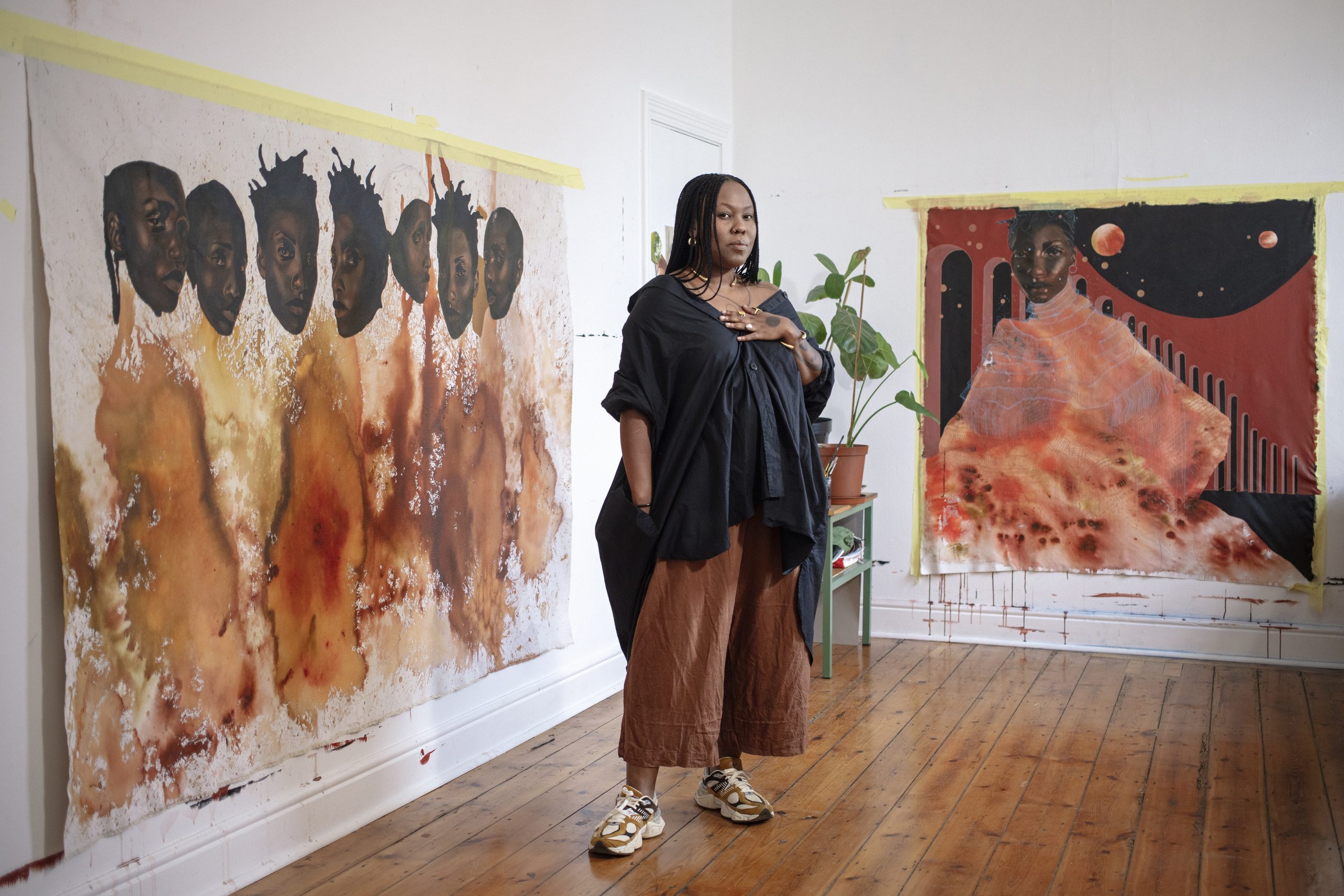
Diasporic debris and celestial cartographies are intriguing expressions for the trailblazing artwork of leading artists, Nigerian-Canadian Oluseye Ogunlesi and South Africa’s Manyaku Mashilo. Here we platform their creations.

Diasporic debris – not a term we frequently come across but one coined by artist Oluseye Ogunlesi to perfectly express the artefacts, materials and objects thrown out and found on his exploration of life. 

Oluseye’s latest exhibition is called Black Exodus: Summer Departure. Put together over the last five years, it features installations, photography and sculptures that touch upon the artist’s personal narratives, reflections and trans-Atlantic travels.

Born in London, Oluseye later spent his formative years as a child in Lagos, Nigeria, and then moved to Canada. The experience of a life spanning three continents, shifting homes and recreating and rebuilding lives gives him plenty of reasons to dissect and explore the migrations and spiritual traditions of Black and diasporic culture. 

Black Exodus reveals: “the notion of Blackness as divine, fluid and unfixed, unbound by time, space and geographies … his work blends the ancestral with the contemporary, the traditional with the modern, the physical with the spiritual, the new with the old and the past with the future.” 

DIASPORIC DEBRIS

The objects and items gathered on Oluseye’s journeys have been recast into sculpture, performance and photography. 

A piece entitled Eminado (meaning good luck charm) examines things that have been discarded and displays them reworked and reborn as talismans contrasting against a white wall – a baby’s dummy, plug sockets, strands of hair in a clasp.

Oluseye says, “Eminado are objects of pleasure and protection, they are re-imaginations of the talismans that Africans – past and present – carried for protection as they embarked on both forced and voluntary journeys across the Atlantic.”   

At the heartbeat of the exhibition is the installation Patra (Mothership) – it could symbolise a womb, the hull of a ship or a carriage. Here Oluseye draws inspiration from one of his earliest memories of Black female empowerment, the Jamaican dancehall star Patra. Within this piece, he considers the symbolism of a ship as a woman – an anchor, steadfast, unswerving. 

“The installation consists of a large sensuous body of hair nestling a porcelain cowrie shell and anchored by a large rock. This work attempts to highlight the contributions of Black women in the artist’s life and across intellectual and physical realms throughout history.”

With the new objects and detritus he has collected, Oluseye reveals how he found himself and created an artistic identity rooted in play, honesty, travel and research. He says, “I am coming into self within this broader examination of Black ancestry, migration, spirituality, aesthetics and visual culture. What’s my journey within these larger, universal themes of Blackness? What is my contribution?”

AN ORDER OF BEING

Seeking to restore and alleviate, bring freedom and new life, Manyaku Mashilo’s exhibition An Order of Being consists of a collection of abstract paintings that communicate an imagined future sphere. 

Born in Limpopo, South Africa, Manyaku is based in Cape Town, and her artistic practice encompasses mixed-media painting, drawing and collage. Her artwork thematically deals with spiritual identity, memory, ancestry, community and belonging. 

Her canvases show elements of her religious experience as well as nodding to her ancestral African heritage, both in lived reality and fantasy through folklore, science fiction, music and archived imagery. 

She says, “I invent characters … I have had to create these subjects from scratch – make skin tones, plan similarities, consider race, exaggerate features – blank my slate while contending with the reality that I cannot unsee or un-know.” 

CELESTIAL CARTOGRAPHIES

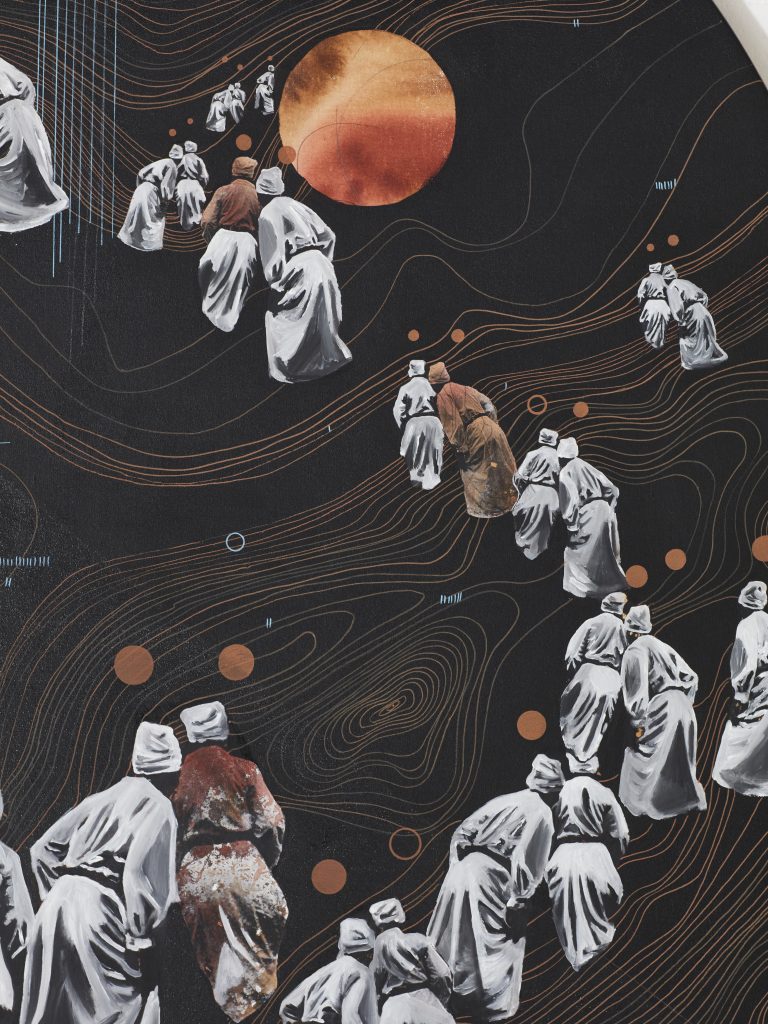
Manyaku’s thematic collections, such as Passage to Prayer and We did not arrive alone, depict vast otherworldly landscapes “weaving together place and space offering a multiverse of imagined future”.

As an archivist and storyteller, some of her figures are based on family photos and portraits from her local community – mixed with photographic archives and imaginary representations of Blackness flowing through a transitional point that she terms “liminal spaces”, with the scenes existing as “celestial cartographies”.

Manyaku says, “I’m trying to imagine different worlds, new ways of thinking about how I exist, how I’ve existed and how time has informed all of this. My practice moves, it’s forever changing. Afrofuturism is really coming to terms with the many selves that I am now. I’m trying to imagine this magical, fantastical world where all these things can live together. I struggle to work in silence … sound is spiritual and the line [in this artwork] is the language to communicate that spirit. This future world is a place of healing and a place of rest.”

SOUTHERN GUILD
Established in 2008, Southern Guild represents contemporary artists from Africa and its diaspora. With a focus on Africa’s rich tradition of utilitarian and ritualistic art, the gallery’s programme furthers the continent’s contribution to global art movements. 

Find out more at www.southernguild.com

Get acquainted with the works of Oluseye Ogunlesi and Manyaku Mashilo by visiting their websites: 

www.olu-seye.com

www.manyakumashilo.com

Destination Dakar

Welcome to the land of the Teranga. Explore Dakar through the eyes of our guest creative director and cover star Sarah Diouf, sharing her favorite and most inspiring places.


“Whenever I’m asked to describe Dakar and what living here feels like, my answer remains the same: you truly have to experience it. There is something about the warmth, the light, the views, and the seemingly organised chaos that cannot translate into words: it is the very essence of the mesmerising spirit of the Teranga that keeps bringing back those who once caught its vibrations.
Dakar is my life’s greatest love story and, for obvious reasons, my affection for the land runs deep; my ode to the city would have been tainted with envy if she couldn’t be mine.
It is where I feel the most at peace, where I feel the most at home, it is where I thrive, and feel the most alive. Dakar welcomes and embraces all, through the streets, the people, the style, she tells a story of pride – and with humility – ffor only she knows and doesn’t have to show yet that she is Africa’s best-kept secret.” – SARAH DIOUF


 Read the full story in our latest issue.


FEW THINGS TO KNOW

  • Dakar is a small city of 1 million people.
  • Senegal is a conservative Muslim country, yet very open to the world.
  • The main languages are Wolof (Naga def means ‘How are you?’, Mangui fi means ‘I am good’), and French.
  • People greet each other in Arabic (Salam Aleykoum means ‘May peace be with you’).
  • The main road along the sea is called the Corniche; it goes from the South (Dakar Plateau) to the north of the city (Les Almadies).
  • The main transportation mode is the taxi (yellow cabs). A ride is always around 2,000 FCFA (Central African franc).


FEW THINGS TO DO

  • Eat a Thieboudieune (aka the original Jollof); legend says the Pullman Hotel makes one of the best in town (a low-key spot to also enjoy one is Chez Loutcha, downtown).
  • Visit Gorée Island.
  • Climb towards the African Renaissance Monument.
  • Get drinks at the LightHouse in Mamelles.
  • Lunch on Ngor Island and enjoy some downtime on the weekend.
  • Visit the Lake Retba (known as the pink lake) and enjoy an ATV ballad on the sand dunes (one-hour drive from Dakar).
  • Visit Bandia’s natural reserve for a surreal experience where you can ride with lions (one-hour drive from Dakar).


Made in Africa

Three years ago, I came across a beautiful black-and-white print jumpsuit.

I can still remember the beat of my jumpsuit-loving heart skipped on seeing it. It was different. It was bold. It was everything.

One click led me to Tongoro’s website – it was love at first on-screen sight. What made the moment even more serendipitous was finding out Tongoro was an African brand. I made my first purchase, received the striking silky-smooth piece in the mail,and realised I needed more.

More Tongoro for my closet, of course – but more knowledge about the artist that created this brand that so spoke to me.

My online research taught me Tongoro – and its stunning cuts and prints – was born from the mind of a Senegalese creator, Sarah Diouf.

Did I immediately head to her personal Instagram account and reach out to her? Yes, yes I did!

African fashion is my love language, people. Fast-forward three years and I’m spending four whole days in Sarah’s home country of Senegal – sitting on the floor in her home, sharing tea and stories.

She is as approachable as they come – her presence isn’t just inspiring, as so many artists’ are, it’s refreshing. Had you told my jumpsuit-loving, online-sleuthing self three years ago I would be writing these words, reminiscing on the most magical shared time with the creator whose work I relished, I would have told you I admired your sense of humour and wild imagination.

Don’t you love when life surprises us with the experiences we are so sure are impossible?

(read the full story in issue 06)

Meet the founder : Suki Suki Naturals

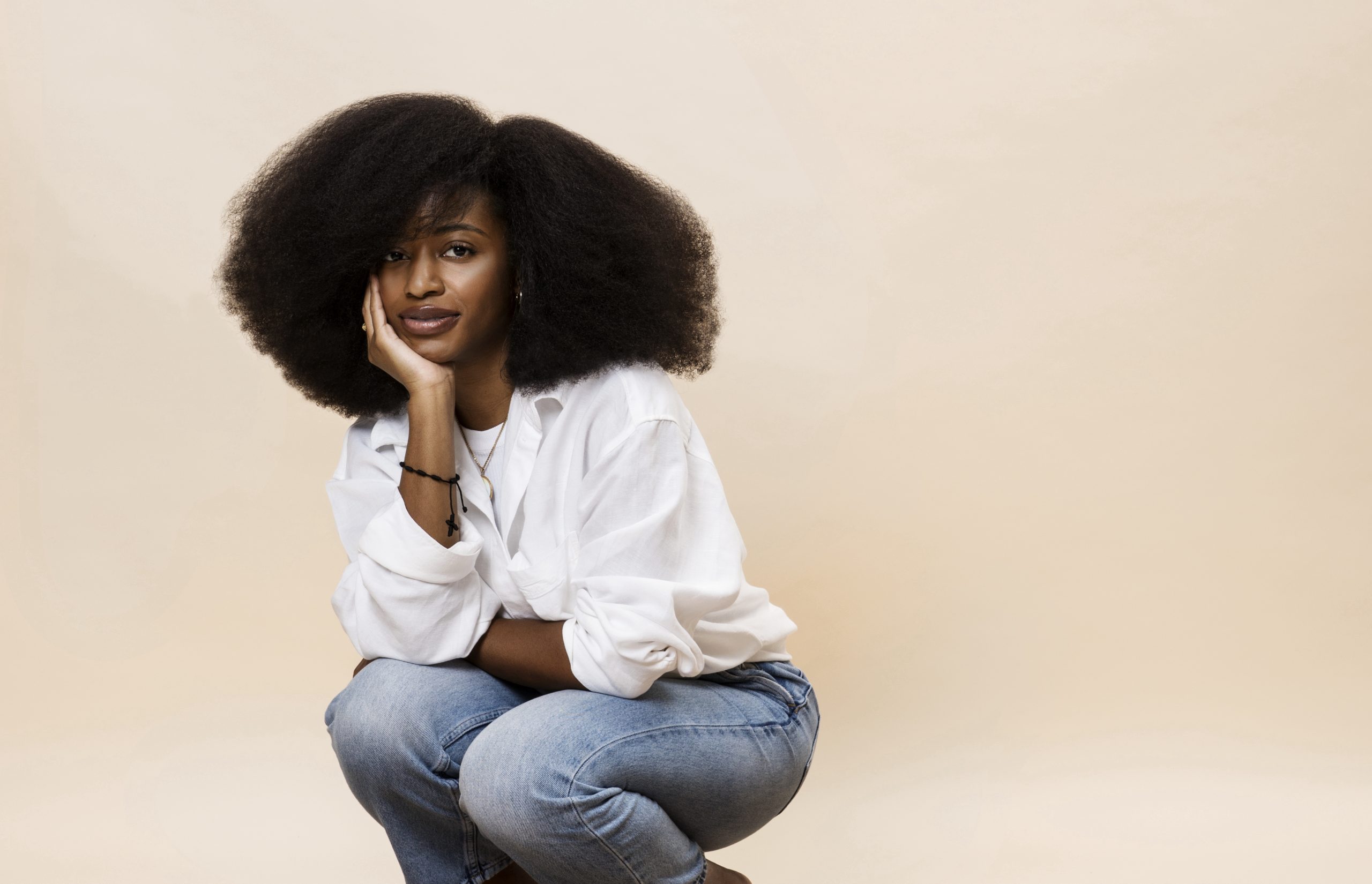
Suki, in Japanese, means a liking of or fondness for. In Arabic, suki means drive. Linda Gieskes-Mwamba, founder of Suki Suki Naturals, took the word and applied it twice to drive a movement, establishing a brand that affirms women of colour in their fondness for their natural skin and hair, using ingredients from nature. That was 10 years ago. 

Motivated to challenge traditional beauty standards and provide inclusive solutions, Linda has created products catering to diverse hair textures and skin types. Her extensive research and expertise have resulted in a range of products that empower individuals to embrace their natural beauty, irrespective of societal norms. Suki Suki Naturals has a genuine commitment to sourcing medicinal ancestral plants while incorporating scientific advancements. By fusing time-honoured African beauty rituals with modern research, the brand offers a unique sensory experience that nourishes, revitalises and connects customers to Africa’s rich heritage.Linda talked to Fifty Four mag’s beauty director, Mathahle Stofile, about her brand’s journey and future plans.

Mathahle:  You started Suki Suki Naturals as a personal project, the seed planted back in 2010 because of your frustration trying to find natural, clean and affordable products for your hair. We’ve come so far since then and the market is flooded with products making similar promises, especially around natural African ingredients. Being one of the pioneers, and you certainly were. How do you get Suki Suki Naturals to stand out in what can feel like a crowded space today? 

Linda: We’re lucky to have built an authentic community around our brand and product. It’s been 10 years, and our growth has been organic, we’re not trying to be any other brand, we’re focused on staying true to our initial promise, to offer people personal care every day made from the natural richness of African raw ingredients through formulations that are backed by science. The quality of our ingredients and the efficacy of our products are at the centre of what we do. 

Skin and hair live in the same place in my head, they follow the same basic rules of keeping the cleansing gentle, going hard on hydration, and always using a protection product before stepping out in the heat. Is this a link you made as you play in these two categories? Why not make-up, for example? 

L: We launched Suki Suki Naturals with a haircare range, and the philosophy behind the range has always been ‘to care’; we used the same philosophy when creating the skincare range. Yes, our ground rules are ultimately the same when caring for hair and skin: cleansing needs to be efficacious yet gentle; moisturising needs to promote moisture retention without suffocating hair or the scalp and without clogging pores; and products need to protect from external aggressors whether that is hard water, pollution, heat styling or the sun. Make-up could be fun, maybe one day.

With such a wide and generous offer from the continent, how do you choose which plant-based ingredients to use? Do you pick the product first or the ingredients first? 

L: We formulate our products with a vision for what we want them to do first; our formulation process is results-driven. After considering the product properties, we determine the kind of application, scent, texture and experience we’d like our customer to have. Our customers often decide this. As a last step, we identify the best ingredients from the continent that can deliver those results without harmful additives.

In the process of creating a brand and bringing it to life in the form of tangible products loved by loyal customers, what have you been most surprised by?

L: I’ve been most surprised by customer loyalty’s huge role in brand growth.

You officially launched Suki Suki Naturals in 2014, but you had been building up to this since around 2010. Tell us about that journey. 

L: I went natural in 2010 but was still studying law then, with no intention of starting a beauty brand. I would make blends for personal use, and during that time, I would share them with family and friends. I left South Africa to go to New York in 2012 to write the NY Bar Exam, and upon my return in 2013, family and friends loved the results they saw in their hair growth and hair health, and they asked for more. I decided to launch Suki Suki Naturals in April 2014.

Do you come from a family of entrepreneurs? What convinced you that you could do this successfully? 

L: Yes, I do come from a family of entrepreneurs. Seeing people around me take the leap in business, which started with my grandparents, I’ve never been intimidated by being an entrepreneur; the worst that could happen is failing and returning to your day job. I was never ‘convinced’ I could do it successfully; I just believed in my vision and I believed that my passion for beauty would take me far. 

What have been some of your challenges, especially when you started shipping outside of South Africa? And how many countries do you ship to in total and how have you handled them? 

L: Exporting can always be challenging, from customs clearance to expediting shipping times, but we learn from our experience to make the process seamless and quick for our customers. We currently ship to the US, UK and Europe. Upon request to various countries from our customers, we always try to accommodate our customers if our products are not available in their country yet.  

What do you wish to see change in the next few years to facilitate smoother trading across different nations in Africa? 

L: A ratified free-trade agreement by all African countries would be a great step forward in fostering better intra-Africa trade.

Many brands are based outside of Africa but are branded as ‘African brands’ because their stories include ingredients and sometimes even characters/muses (mom/grandma) from here. I imagine there are many reasons for this. It’s frustrating because we are still known for consuming too much and not producing enough as Africans, even though we own the raw materials. Would you ever consider manufacturing and operating outside the continent but still sourcing ingredients from here? 

L: Our brand believes in African-made finished goods composed of African ingredients. This is why we’re authentically African, we’re not just using it as a tagline to exotify our brand and product. If we were to manufacture outside the continent, it would be if it’s literally no longer possible to find laboratories and factories in Africa. 

Which Suki Suki Naturals products are your family members’ favourites?  

L: Miraculous Oil is a family and friends favourite and Rosehip Brightening Facial Oil.

The entrepreneurship journey is famously lonely. Who do you have in your corner when things get dark? 

L: My mother, my sister, my friends, my partner and my Suki Suki Naturals community. 

Any wellness rituals you depend on? 

L: Early morning prayer walks, pilates and yoga. I love my morning ritual of making matcha.

My beauty routine, whether morning or evening, is also a big part of helping me slow down and keeping me grounded and present.

What are the future plans? 

L: Launching our new website, celebrating 10 years and releasing more products

our community loves.

Visit www.sukisukinaturals.co.za

Exalting Angola’s ethnic groups

Boundless deserts, vast coastal plains and a maze of tributaries and rivers binding like veins across the country, Angola has all the biodiversity and landscapes you could imagine. 

As the seventh largest country in Africa and the 24th largest in the world, its coastline on the southwest of Southern Africa welcomes the mysterious expanse of the Atlantic Ocean, journeying through tropical rainforests in the north and the hills and mountains of the western-central highlands. 

Its population of 36 million people shares borders with neighbours Namibia, the Democratic Republic of Congo, Republic of Congo and Zambia – making it flush with the cultural magnificence of different influences and ethnicities. 

Today, the three main ethnic groups are Ovimbundu, Ambundu and Bakongo, and over 90 different tribal groups make up its small indigenous population. 

In this feature, we share beautiful portraits and rare imagery from life with some of Angola’s most isolated tribes, such as the Ovanguendelengo, Ovakuvale, Ovahanda, Ovahimba, Ovadhimba, Ovatwa, Ovamwila, Ovahakaona and Ovangambwe people living in the south provinces of Namibe and Cunene. 

Reports estimate that around 25,000 of the total population are indigenous. 

Groups often live in complete isolation or a semi-nomadic lifestyle dependent on their sheep or goats. For the most part, they are untouched by the invasive cloud of westernisation that gained ground after Dutch and Portuguese colonisation in the 15th century. 

The kaleidoscope of bright colours within their clothing and materials defines their spirit against the backdrop of brown and beige arid desert landscapes – a terrain that is increasing due to desertification. 

Many women like the Ovamwila significantly alter their appearance as they grow from girls to women and will often use different necklaces or hairstyles such as braids and dreadlocks to symbolise the change. Young women, once married, often have braids called nontombe – when hair is coated with a mixture of red and yellow ochre, oils, manure, herbs and crushed tree bark.Ovakuvale tribal women traditionally wear an ompota – a large square or rectangular headpiece made of colourful fabric. Their bra, called an oyonduthi, is a strap that is tied around their breasts to stop movement as they walk. Many tribal women go about daily life.

bare-breasted, free from the conservatism of Western life – they are living in the present as they are – as they have always been.

The Ovahakaona have distinct hairstyles and braids and often a front piece that is coated in black plant resin. Their tribal accessories include fine colourful beads mixed with cowrie shells. 

The Ovadhimba dress with multicoloured headscarves, while the Ovahimba wear an erembi headdress made from sheepskin. Older Ovamwila women have striking necklaces called vilanda that are stacked from the décolletage area to the chin – they don’t like to take it off and the weight means that they sleep on a headrest at night.

What is wealth?

Full to bursting with the world’s natural resources, such as diamonds, gold, copper, iron and petroleum, you would think that Angola is one of the world’s wealthiest countries, but despite living above the earth’s riches, it remains one of Africa’s poorest – with corruption, weak governance and a history of war blighting economic development. 

Even today, the country’s self-penned ‘elite’ make news headlines in cases of suspected fraud. But these are the riches that capitalists and those who are unconnected to the land pursue. At Fifty Four mag, as we platform and exalt Angola’s tribal groups, we share riches of an age-old, deeper, spiritual dimension – the cultural wealth of lasting traditions of the people that have come before us.

Angolan facts

  • Portuguese is the official language but at home tribal languages are often spoken such as Umbundu, Kikongo and Kimbundu.
  • Around 25,000 of the total population are indigenous.
  • The Angolan Civil War saw over 30 years of conflict, rooted in an anti-colonial uprising but also tribal and regional tensions.
  • The World Food Programme (WFP) reports that 1.3 million people in southwestern provinces are facing severe hunger.

Carpet Diem

Artsi has spent his career sharing how slow ethical fashion does not bow down to the whims of consumers, the fashion world’s flash-in-the-pan seasonal collections or fad focus on trendy textures or fabrics, but rather it uses materials sourced from local artisans and the ancient markets of the world to symbolise our discovery that the earth is ours to embrace and live in harmony with, to wrap around us, receive solace from, and ultimately take good care of in the ever-lasting long-term of life itself.