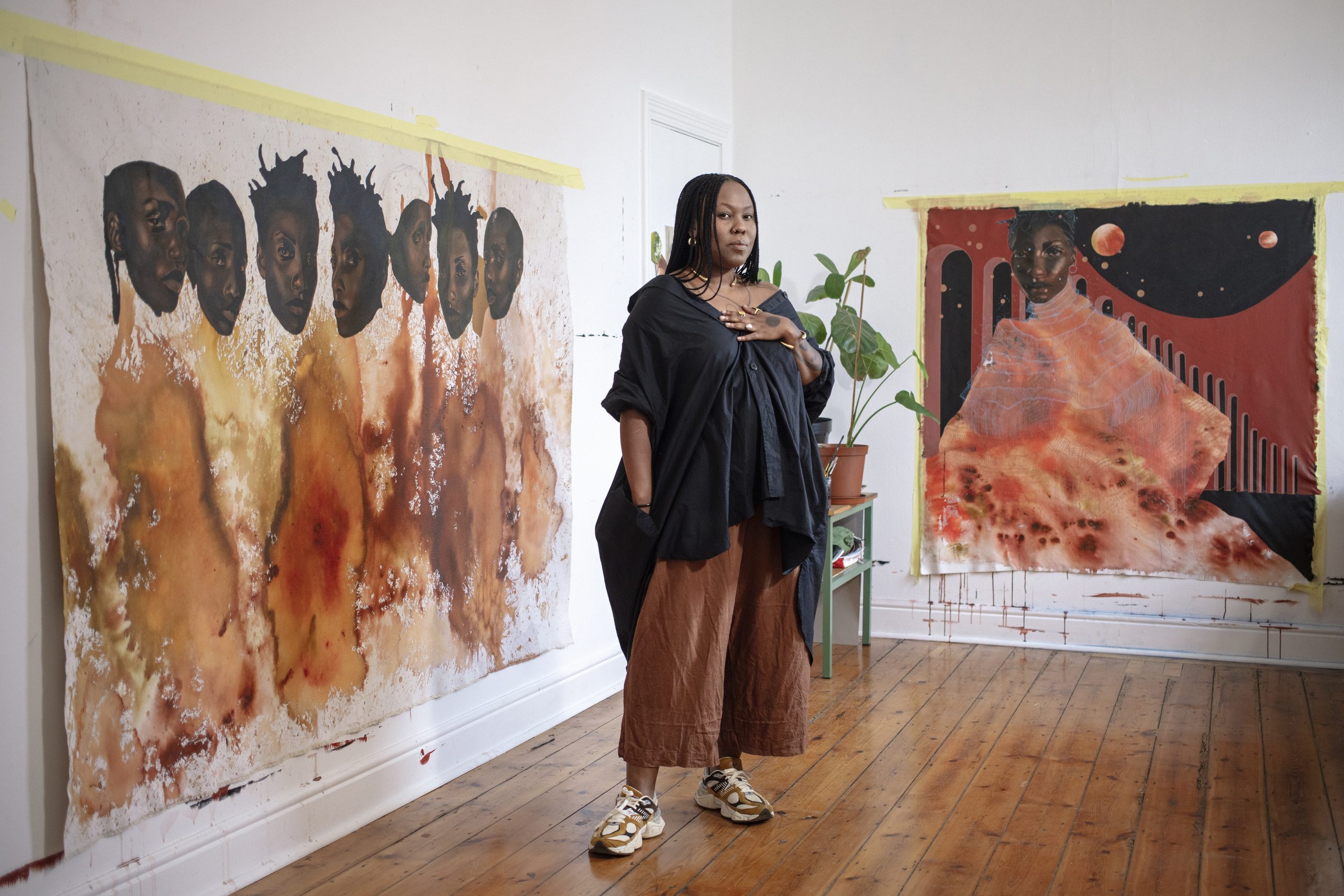
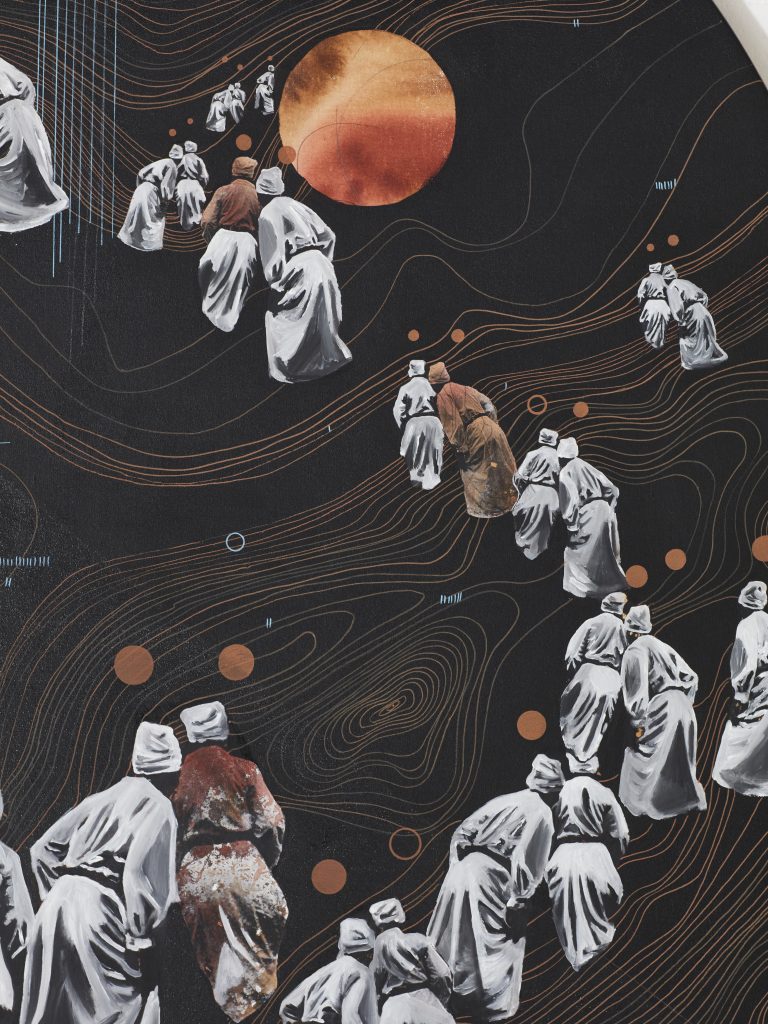
Diasporic debris and celestial cartographies are intriguing expressions for the trailblazing artwork of leading artists, Nigerian-Canadian Oluseye Ogunlesi and South Africa’s Manyaku Mashilo. Here we platform their creations.
Diasporic debris – not a term we frequently come across but one coined by artist Oluseye Ogunlesi to perfectly express the artefacts, materials and objects thrown out and found on his exploration of life.
Oluseye’s latest exhibition is called Black Exodus: Summer Departure. Put together over the last five years, it features installations, photography and sculptures that touch upon the artist’s personal narratives, reflections and trans-Atlantic travels.
Born in London, Oluseye later spent his formative years as a child in Lagos, Nigeria, and then moved to Canada. The experience of a life spanning three continents, shifting homes and recreating and rebuilding lives gives him plenty of reasons to dissect and explore the migrations and spiritual traditions of Black and diasporic culture.
Black Exodus reveals: “the notion of Blackness as divine, fluid and unfixed, unbound by time, space and geographies … his work blends the ancestral with the contemporary, the traditional with the modern, the physical with the spiritual, the new with the old and the past with the future.”
DIASPORIC DEBRIS
The objects and items gathered on Oluseye’s journeys have been recast into sculpture, performance and photography.
A piece entitled Eminado (meaning good luck charm) examines things that have been discarded and displays them reworked and reborn as talismans contrasting against a white wall – a baby’s dummy, plug sockets, strands of hair in a clasp.
Oluseye says, “Eminado are objects of pleasure and protection, they are re-imaginations of the talismans that Africans – past and present – carried for protection as they embarked on both forced and voluntary journeys across the Atlantic.”
At the heartbeat of the exhibition is the installation Patra (Mothership) – it could symbolise a womb, the hull of a ship or a carriage. Here Oluseye draws inspiration from one of his earliest memories of Black female empowerment, the Jamaican dancehall star Patra. Within this piece, he considers the symbolism of a ship as a woman – an anchor, steadfast, unswerving.
“The installation consists of a large sensuous body of hair nestling a porcelain cowrie shell and anchored by a large rock. This work attempts to highlight the contributions of Black women in the artist’s life and across intellectual and physical realms throughout history.”
With the new objects and detritus he has collected, Oluseye reveals how he found himself and created an artistic identity rooted in play, honesty, travel and research. He says, “I am coming into self within this broader examination of Black ancestry, migration, spirituality, aesthetics and visual culture. What’s my journey within these larger, universal themes of Blackness? What is my contribution?”
AN ORDER OF BEING
Seeking to restore and alleviate, bring freedom and new life, Manyaku Mashilo’s exhibition An Order of Being consists of a collection of abstract paintings that communicate an imagined future sphere.
Born in Limpopo, South Africa, Manyaku is based in Cape Town, and her artistic practice encompasses mixed-media painting, drawing and collage. Her artwork thematically deals with spiritual identity, memory, ancestry, community and belonging.
Her canvases show elements of her religious experience as well as nodding to her ancestral African heritage, both in lived reality and fantasy through folklore, science fiction, music and archived imagery.
She says, “I invent characters … I have had to create these subjects from scratch – make skin tones, plan similarities, consider race, exaggerate features – blank my slate while contending with the reality that I cannot unsee or un-know.”
CELESTIAL CARTOGRAPHIES
Manyaku’s thematic collections, such as Passage to Prayer and We did not arrive alone, depict vast otherworldly landscapes “weaving together place and space offering a multiverse of imagined future”.
As an archivist and storyteller, some of her figures are based on family photos and portraits from her local community – mixed with photographic archives and imaginary representations of Blackness flowing through a transitional point that she terms “liminal spaces”, with the scenes existing as “celestial cartographies”.
Manyaku says, “I’m trying to imagine different worlds, new ways of thinking about how I exist, how I’ve existed and how time has informed all of this. My practice moves, it’s forever changing. Afrofuturism is really coming to terms with the many selves that I am now. I’m trying to imagine this magical, fantastical world where all these things can live together. I struggle to work in silence … sound is spiritual and the line [in this artwork] is the language to communicate that spirit. This future world is a place of healing and a place of rest.”

SOUTHERN GUILD
Established in 2008, Southern Guild represents contemporary artists from Africa and its diaspora. With a focus on Africa’s rich tradition of utilitarian and ritualistic art, the gallery’s programme furthers the continent’s contribution to global art movements.
Find out more at www.southernguild.com
Get acquainted with the works of Oluseye Ogunlesi and Manyaku Mashilo by visiting their websites: